Marri
Marri is a West Australian Hardwood. Hardness level excellent. It has lightish coloring with pale brown tones, yellows, reddish browns and occasional shades that are greenish. A lot of effort is required in the drying stage to get Marri to dry correctly for use in timber flooring. Indeed, it took a lot of time for the industry to develop a suitable drying process. It is particularly important that Marri is on-site for a reasonable length of time to acclimatize. Refer to the section on acclimatization discussed earlier in this book. As a preliminary suggestion a minimum of three weeks appropriately stacked inside the house would be advisable.
Marri has more feature than other timbers – the examples below illustrate this point. Standard and better and feature grades.
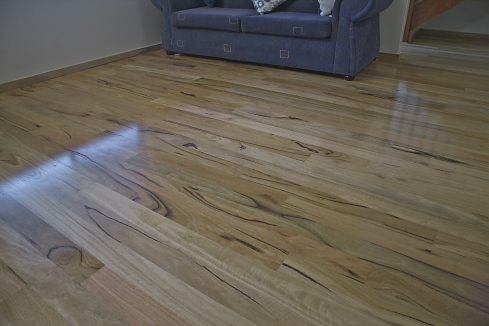
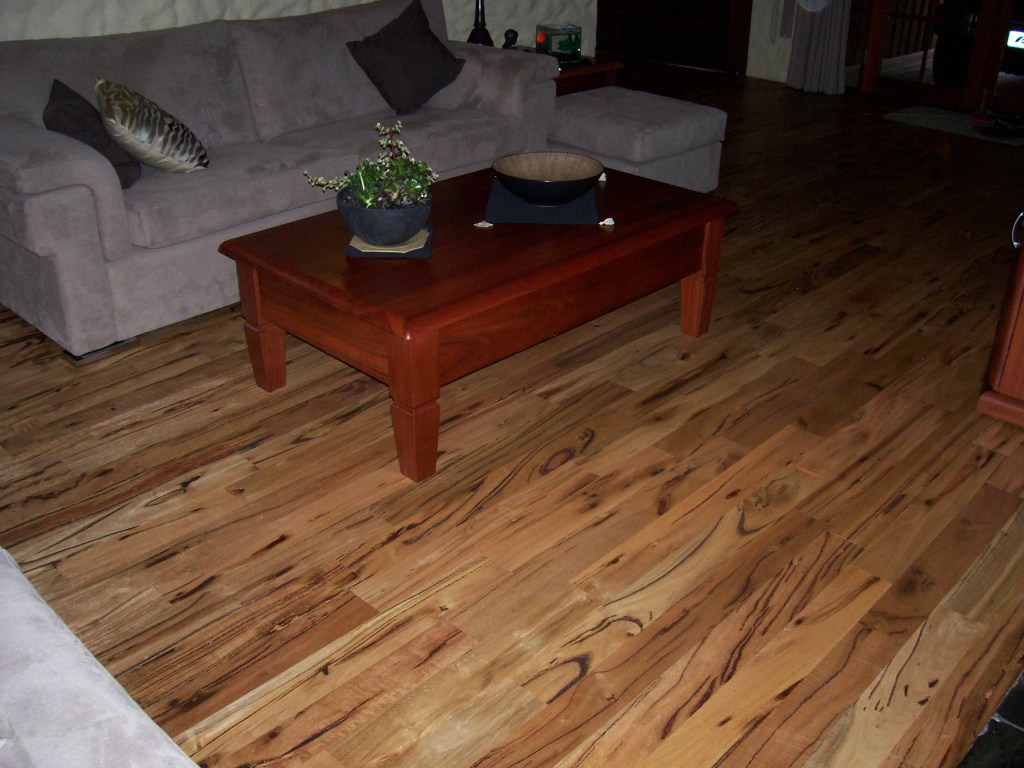
Marri timber has a high proportion of gum veins and therefore it is difficult to apply standard grading rules to this hardwood. Standard and better floors made from Marri always have a reasonable proportion of longer gum veins and this is part of its appeal. You choose Marri for character. Many clients prefer a more featured grain and character and for these Marri is a great choice. A standard and better floor is achievable but again, it has extra gum vein because that is the nature of the timber.
It has a lot of dark veins and care should be taken if these are over 20mm wide and run through the timber as the honey-combing is quite weak. Stuck to concrete this is ok but it must be firmly in place as this is clearly a weakness. Standard and better grades do not usually have a high proportion of ‘wide gum marks’ though there will usually be more gum evident than other species. Marri is chosen for its gum veins and details.
Sanding; Marri is a hardwood. Sanding machines are very effective when used on this timber. It can be sanded to a very fine finish suitable for all finish types. Whereas with some timbers there is a large range of density from piece to piece, Marri is more even and therefore it is possible to achieve a very even finish at the sanding stage. Marri feels fibrous when sanding and requires some time to ensure a good result.
Marri accepts most types of coatings. Solvent based finishes in two packs and single packs have been used for a long time with this species. Marri darkens considerably with some solvent formulations and this needs to be explained to any client. Waterborne finishes also work well with Marri though there is a need to work quickly as sometimes strong shading can occur. It is important to determine the correct sealer with waterborne finishes as shading can be dramatic with the wrong base. Oils have been used extensively with Marri with good effect. It should be noted that due to the high density of Marri the oil coverage may need to be varied significantly for a good result. Often oils are tested on more open timbers such as Oak and the take up of oil is greater on these species. Applying too much oil on Marri can cause problems with a blotchy finish that doesn’t dry out. Oil on the gum veins can cause slow drying. Liming is a popular notion however it is difficult to obtain the correct take-up of solution on Marri due to the high density and the fibrous pattern.
General Comments.
Marri is a proven character Australian hardwood that is ideal when used in flooring. It wears well, looks excellent and is good to work with. With filling the black gum marks have caused some discussion. Some sanders fill the marks black whereas others use a clear resin. Still others don’t fill the gum marks at all. This needs to be decided prior to sanding.
Marri Flooring.
Marri is an amazing timber full of detail and character. Choose Marri for a floor that makes a real statement.


 vcs floorworks PERTH everything for flooring
Leave a comment